Upload the plan set. Pipe runs, structures and erosion control come back found, classified and measured — in real feet, with the evidence for every line — before an estimator picks up a tool.
No new discipline to learn. The platform does the tracing an estimator would have done by hand, then asks you to confirm it — item by item, at keyboard speed.
A PDF, a whole ZIP of them, or the CAD drawing itself. Tag which sheet is which — or let it work that out — and walk away. The bell rings when the markup is ready.
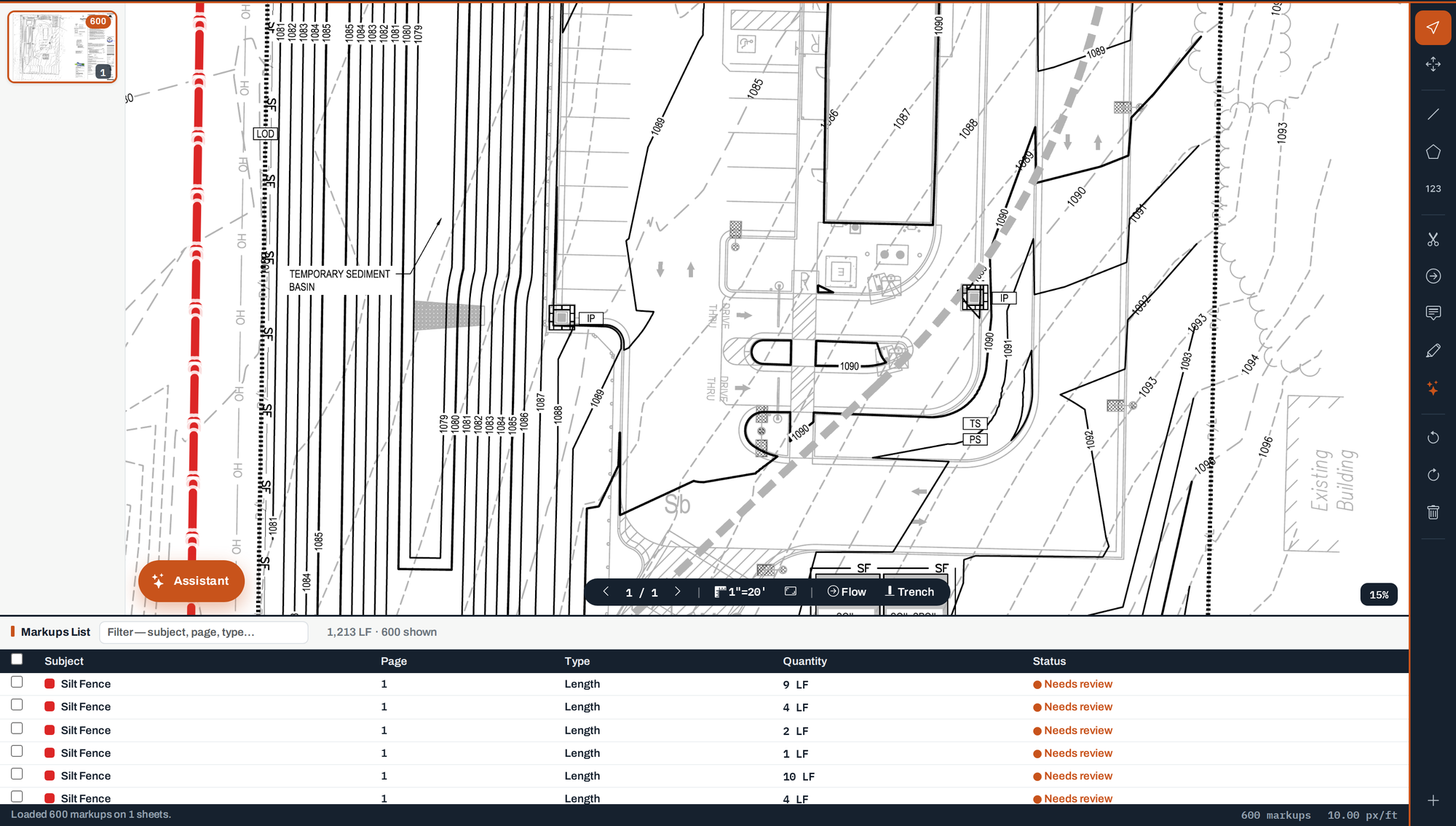
The printed scale bar is measured, the CAD layers are read, pipe runs and erosion items are traced from the engineer's own linework and labels, and every find is checked before it reaches you.
Work the review queue with Y and N. Quantities roll up live into the workbook your estimators already use — and into a client-ready PDF when you need one.
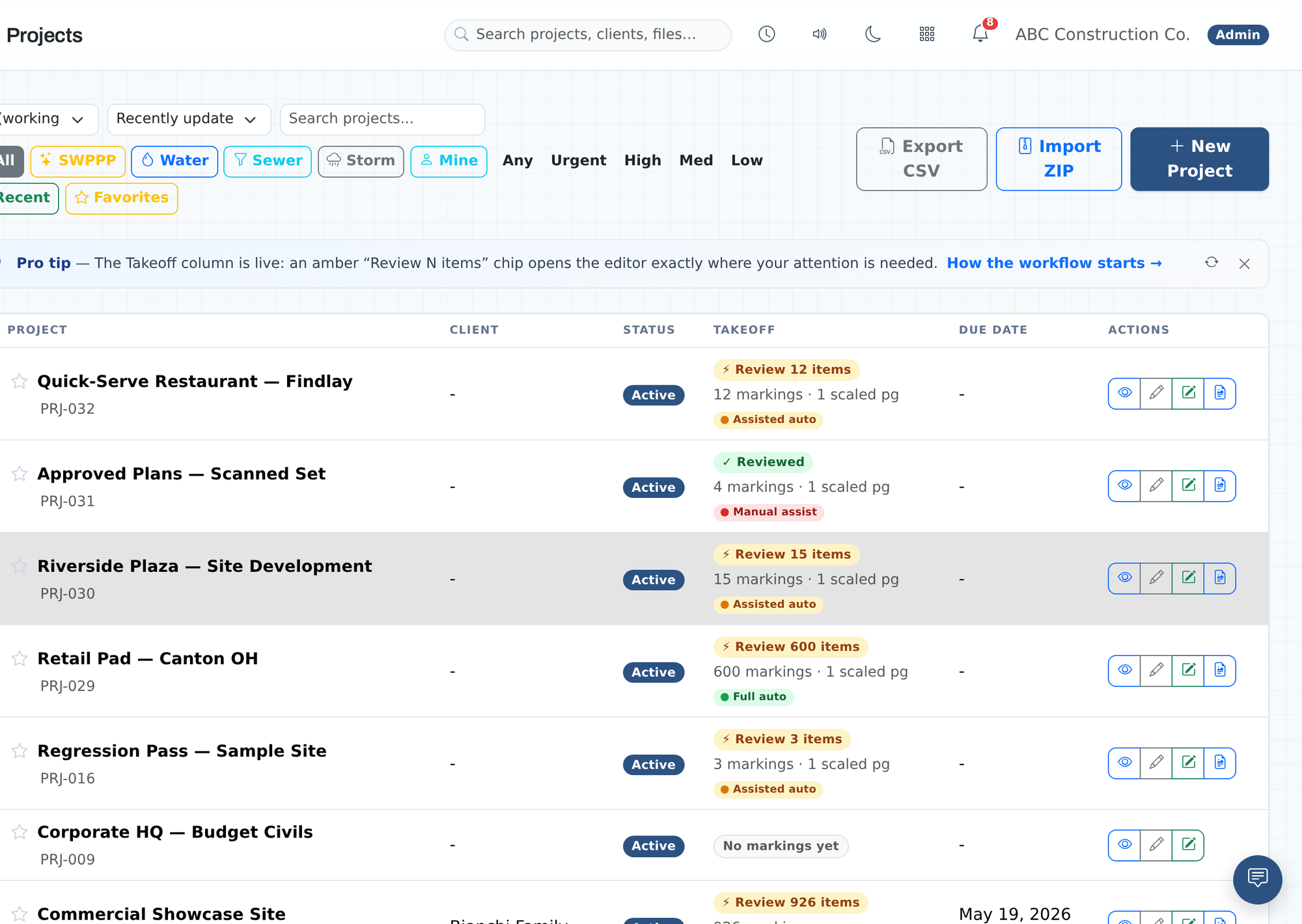
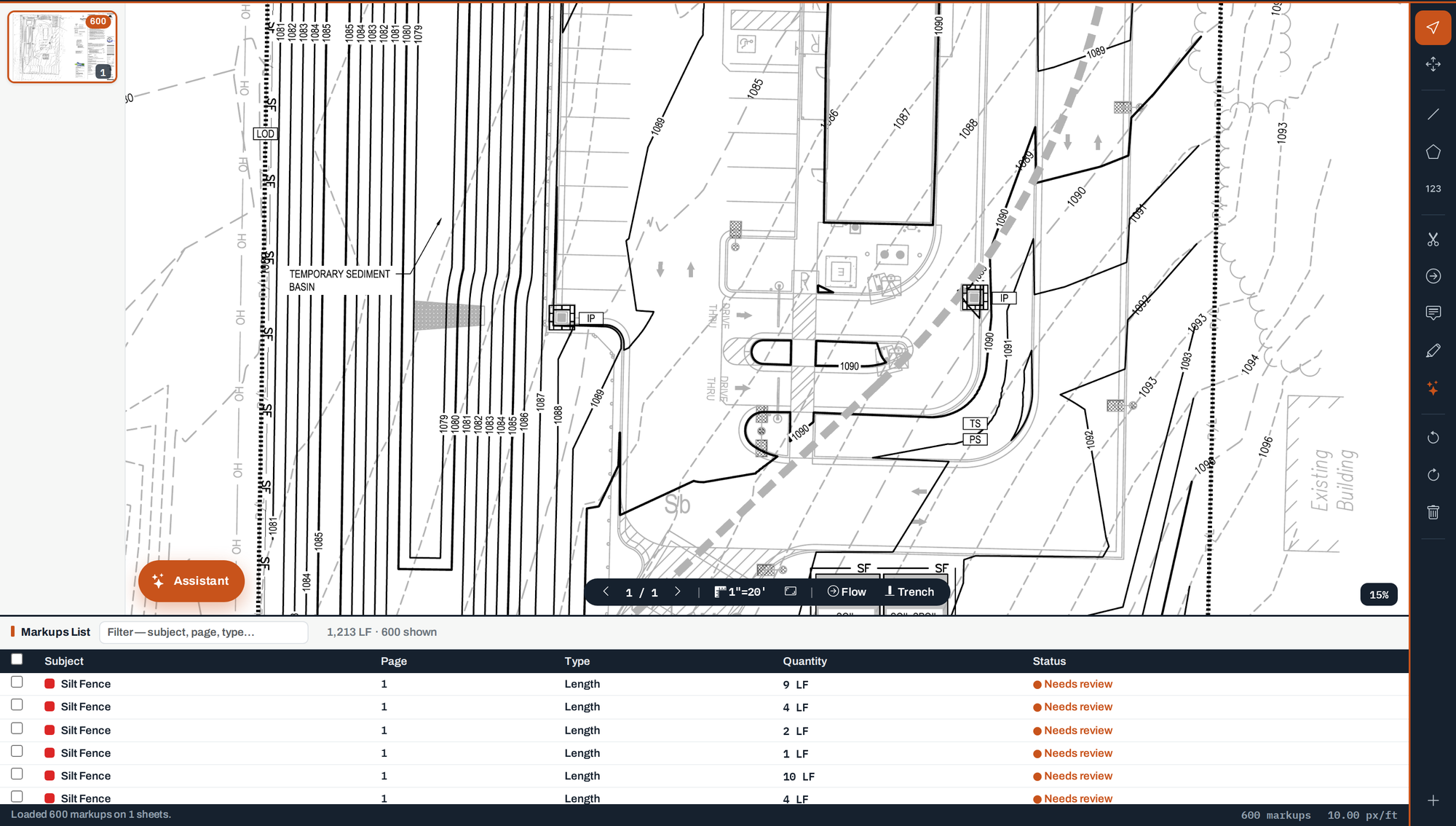
The list tells you what the platform did and what it wants from you: how many items are waiting, how many sheets are scaled, and how much of the work was automatic.
A takeoff is only worth the scale behind it. The platform measures the printed scale bar itself, and where it cannot verify one it leaves the cell blank and says scale required — rather than printing a number you might bid.
Not a generic document tool pointed at drawings. Every behaviour below exists because an estimator hit the problem on a real bid.
A .dwg or .dxf is plotted for you at a proper engineering scale with every layer intact — exact layers, exact scale, nothing to calibrate.
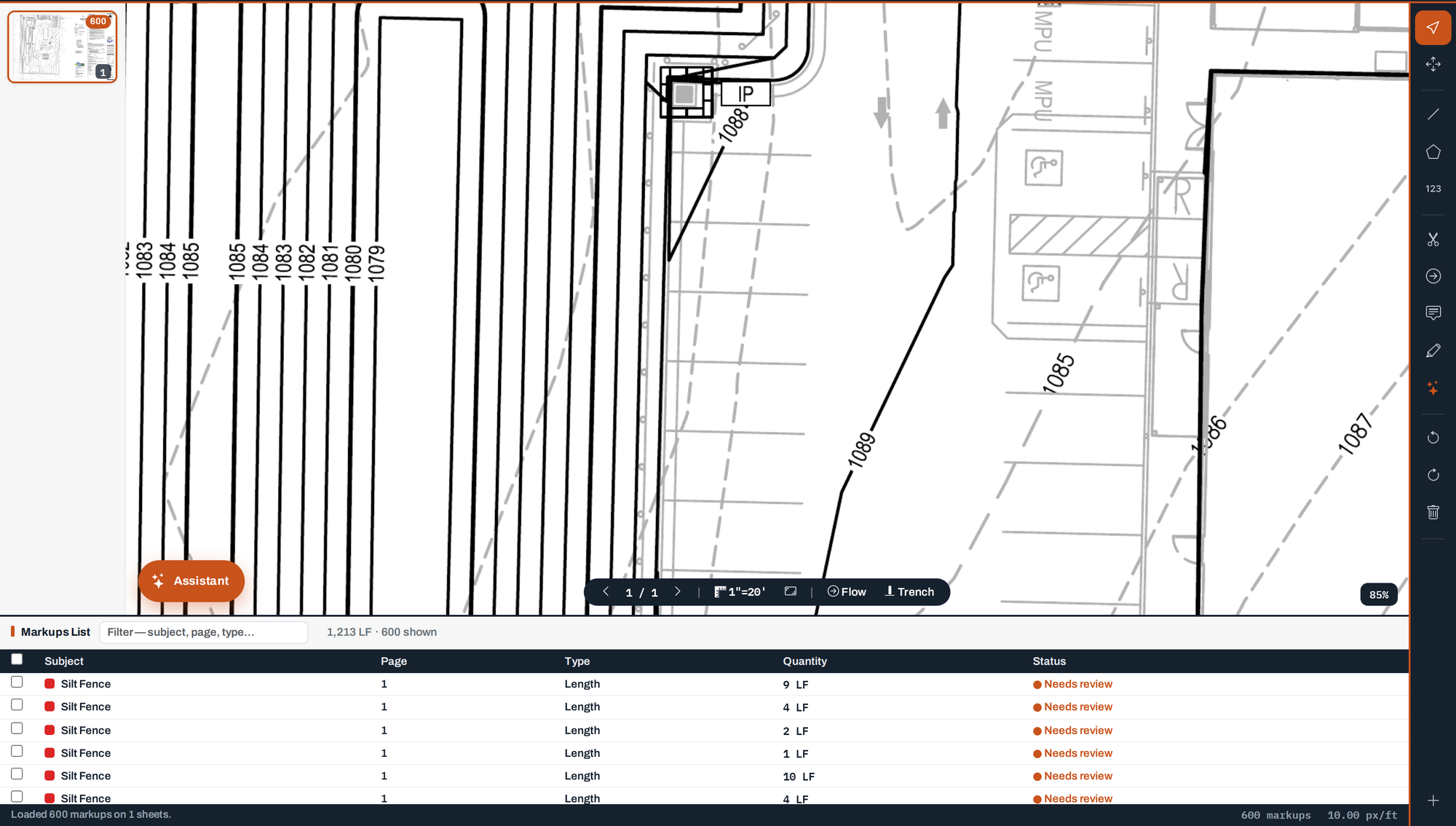
Click any line and the run traces itself — through label gaps, printed dashes and crossings. Then it offers every other line drawn the same way as one batch.
Each marking shows its source: the CAD layer it came from, the plan label it was traced from, the schedule row that set its size. You review facts, not guesses.
Utility sheets print a pipe schedule. It is read and attached, so rows arrive as 18" RCP storm and 8" PVC sanitary — not as anonymous lengths.
Import your Revu tool chest one-to-one, and export the plan with every item as a real, editable markup you can open in Bluebeam.
When a pass does not look right, one click re-examines the mapped sheets against the plan — callouts, linework and schedules — and reports what it changed and why.
Quantities roll into the three-sheet estimator workbook — earthwork, erosion control, utility — with size, material and length on every row. Plus a branded takeoff report when the number has to leave the building.
Every plan includes the full takeoff engine. What changes is how much work you put through it.
Erosion control, earthwork, demolition and fence are separate modules — switch on what you bid.
About an hour and a half of review on a typical set — the platform does the tracing and the counting first, and what you spend your time on is confirming it. A small sheet is minutes. You are not learning a new way to work; you are checking work that is already done.
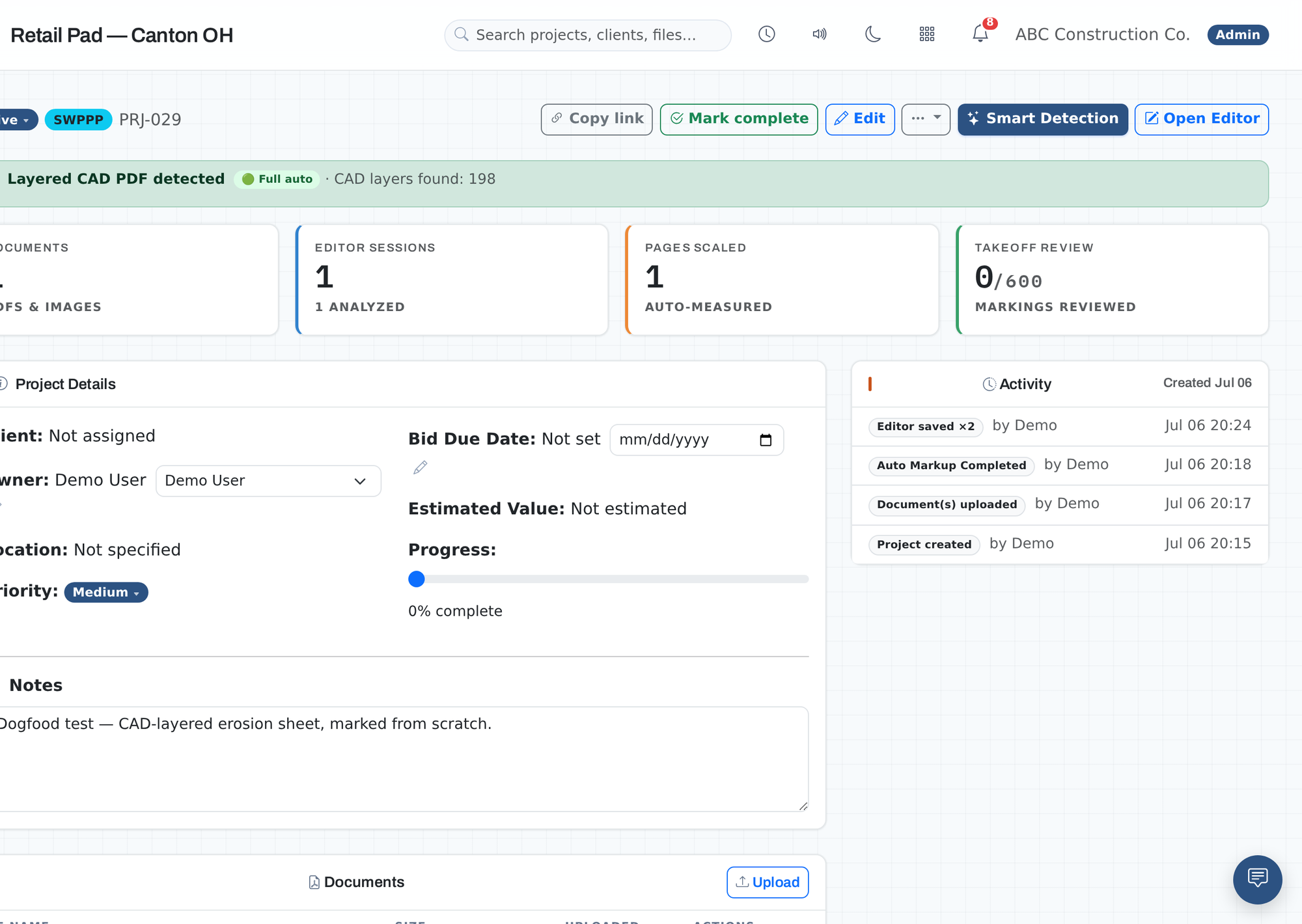
It still works, just differently. A layered CAD PDF is read directly from the engineer's layers — the most complete result. A flattened or scanned sheet falls back to image detection: items are suggested and flagged for your eyes rather than presented as fact. The platform tells you which kind you uploaded, and why it matters.
Every marking carries its evidence, and nothing is counted until a person confirms it. Where the scale cannot be verified, the length stays blank and says so — the one thing a takeoff must never do is print a confident wrong number.
Yes — upload the .dwg or .dxf itself. It gets plotted at a standard engineering scale with every layer preserved, which is the most accurate input the platform accepts: the layers are exact rather than recovered from a print, and so is the scale.
Yes. You see who else is on the plan and which sheet they are on, their markings appear as they make them, and saves merge item by item — so nobody's work is overwritten by someone else's autosave.
In your own workspace, separated from every other company at every page and every API call. Larger teams can have the platform served from their own web address and certificate.
That is the only test that settles it. Upload a set you have already taken off by hand, and see what comes back.
Start free